

I once had a colleague who never had a good plane ride, never had a great meal, and never liked any hotel room she stayed in. Ever. I know because I heard about it the next day. The funny thing is that I was on the same plane, which was fine, ate at the same restaurant and had a very nice meal, and my hotel room was clean and comfortable. Little Miss Complaints and her counterpart and constant companion, Mr. Whiner, never met a good situation that they couldn’t make worse.
Somehow Little Miss Complaints would find the black lining in a silver cloud and if there was nothing to complain about today, there was always yesterday to pick over again. She also latched on to and even sought out other complainers to go through their miseries together. While many of us would spend late nights in hotel bars laughing about the regular misfortunes of constant travel, a small group of whiners and complainers could always be found in a quiet corner being quite content to be miserable.
Little Miss Complaints and Mr. Whiner at the office are busy reciting a whirlwind of not, or never good enough situations. The photocopier, the printer, the telephone system, the benefits, the hours, the pay, oh my God, talking about salaries was good for a complete lunch. None were satisfactory to meet their high standards or requirements. Complaints were constant and everything was up for its share of critique. The weather, diseases or ailments, including those that they were never going to get, were always at the forefront of his mind and her lips.
Worst of all was to have Little Miss Complaints or Mr. Whiner as your supervisor. Not only did you have to endure their stream of complaint consciousness but you also had the pleasure of having your work and performance reviewed by a faux perfectionist. A real perfectionist would set a standard of excellence and help you to achieve the same level. These guys offered constant criticism with no encouragement or possibility of success. The best hope is that they might envelope themselves into a cloud of self-pity and ignore you. Otherwise prepare to meet the supreme nit-picker.
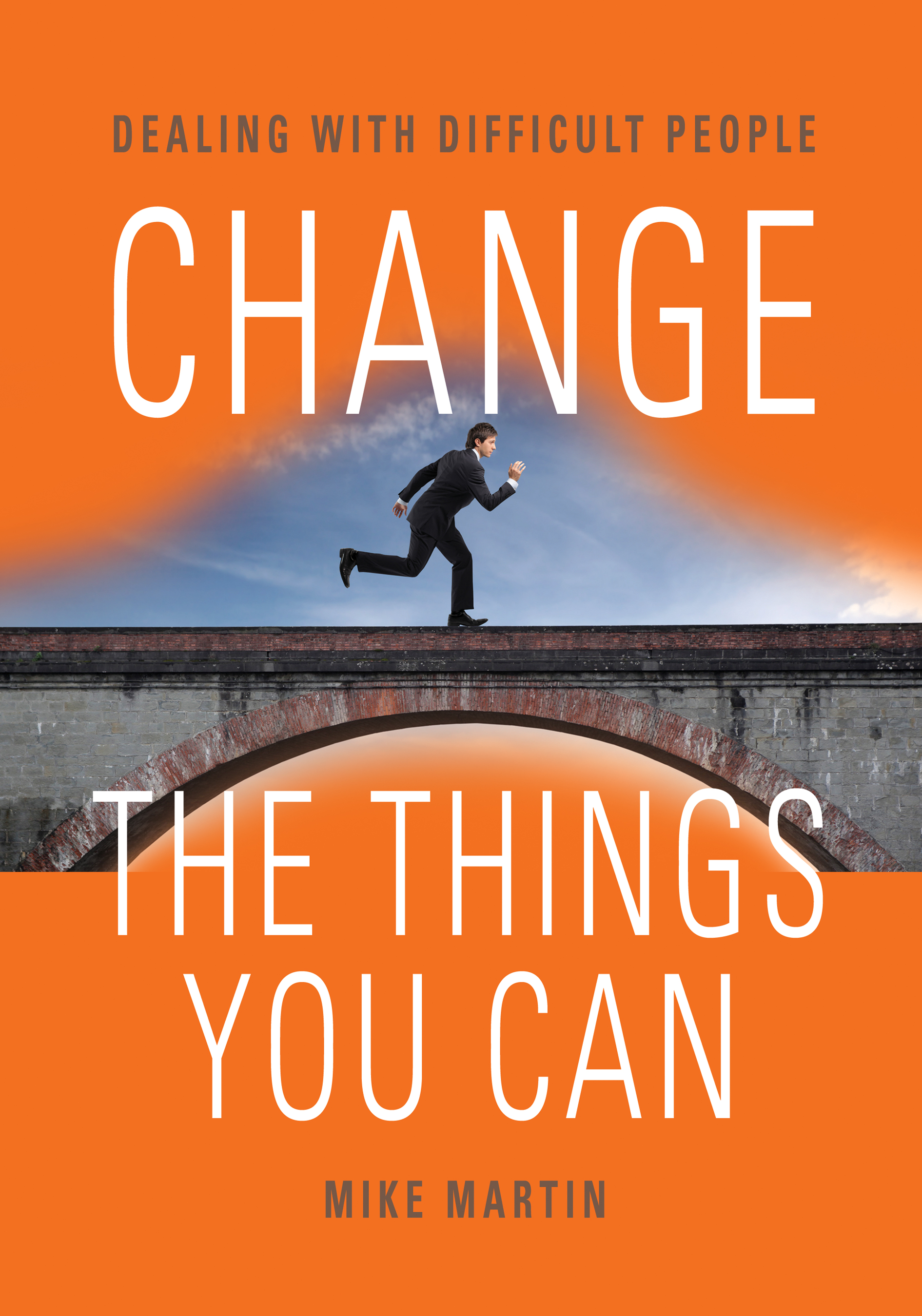
(Excerpted from “Change the Things You Can: Dealing with Difficult People” by Mike Martin. Available at Chapters.ca, Amazon.com, and Booklocker.com)
www.changethethingsyoucan.wordpress.com
This post first appeared on my blog at www.jobs.ca
Mike Martin is a freelance writer and the author of The Walker on the Cape

Mike Martin has produced a very compelling police procedural set in Grand Bank on the coast of Newfoundland. From main character Winston Windflower on down, he has created a group of people that you want to get to know better; hopefully in future stories and other circumstances.
The Walker on the Cape contains a well executed plot and an ending you are not expecting; vital elements in this genre of fiction. The visual of the lighthouse on the front cover does a lot to establish the setting and Martin’s description of the locale makes it integral to the feel of the story.
I look forward to the next adventure of Windflower and company.
Michael MacDonald Ottawa, Ontario

There are many ways to get the right answer but only if you know the right question. The great scientist and futurist Carl Sagan had this to say on the subject: “We make our world significant by the courage of our questions and by the depth of our answers.”
In our everyday lives and too often in the workplace we ask the wrong question and we certainly tend to focus on quantity versus quality when it comes to asking questions. There may indeed be no “stupid” questions but there are questions that can help get closer to the truth and others which pull you far, far away.
In general there are two types of questions. There are questions that seek to learn and questions that seek to judge or get a person to lean our way in an argument or dispute. Judging and leaning questions are really looking to assign blame, defend an already held position or move another person closer to our point of view. Learning questions however are actually looking for new information and facts and sharing responsibility to resolve or improve a situation.
Another way to look at questions is to categorize them as powerful or power- draining questions. Powerful or empowering questions might be like what might best work for you in this situation or when are you most effective? Power-draining questions might be what went wrong here or how could this have happened? You can see how one set or style of questions might produce a completely different answer and result.
If you really want to improve a situation or get information that can correct a problem it is much better to ask a question in a way that allows the person to actually give you something to work with rather than retreating behind the cone of silence or even worse giving you incorrect information. Many times this means asking the question in a neutral way that shows you are not on a witch hunt. That might mean prefacing your question with a comment like “I’m not blaming anybody.. I just want to know what went wrong.” Then ask your question and watch as the tension drains from the other person’s face.
The other major thing to focus on in getting the right answer is to actually listen to the person who is trying to answer your question. We have two ears and one mouth for a reason. Ask your question as neutrally or powerfully as you can and then wait and wait and wait for the answer. Don’t ask another question while you’re waiting. Don’t try to pre-empt their answer. Sometimes people are just thinking or maybe they are trying to decide if they can trust you.
Ask the right question, in the right way, and wait for the response. You just might get the right answer.
Mike Martin is a freelance writer and workplace wellness consultant. He is also the author of the new book “The Walker on the Cape.” For more information please visit:

June 29, 2012
Baico Publishing and Mike Martin are pleased to announce the release of “The Walker on theCape”. This is the first in a series of stories featuring RCMP Sgt. Winston Windflower, a Cree from Northern Alberta who finds himself stationed in Grand Bank,Newfoundland.
Except from the back cover of “The Walker on theCape”
A man’s body is found on the Cape overlooking Grand Bank,Newfoundland. At first everyone thinks it’s a heart attack or stroke. But then it is discovered that he was poisoned. Who would do this and why? Finding that out falls to Sergeant Winston Windflower of the RCMP along with his trusted side-kick Eddie Tizzard. Along the way they discover that there are many more secrets hidden in this small community and powerful people who want to keep it that way.
Windflower also discovers two more things; a love of living in a smallNewfoundlandcommunity that is completely different from his up-bringing in a Northern Alberta reserve and maybe the love of his life. He gets a taste of Newfoundlandfood and hospitality as well as a sense of how crime and corruption can linger beneath the surface or hide in the thick blanket of fog that sometimes creeps in from the nearbyAtlantic Ocean.
Mike Martin was born inSt. John’s,Newfoundlandand now lives and writes in Ottawa. This is his first fiction book. He is a long time freelance writer and the author of “Change the Things You Can: Dealing with Difficult People.”
For more information or to obtain a review copy please contact Mike Martin at mike54martin@sympatico.ca or visit http://www.walkeronthecape.com

I remember when I was first exposed to an open concept office environment. The reaction of me and my co-workers was one of shock and dismay. How could they take away the privacy of my walls and replace them with what looked like styrofoam dividers, a fake plastic window and no ceiling above me to drown out the noise of my busy workmates? Productivity and performance will fall we warned and we were sure that if there was a sky above us it would fall as well.
Flash forward to today and no one blinks at an open office and many workers wonder exactly what they would do in their private lair. Today’s workplace is about circulating air, ideas and people and the fewer barriers between any of them the better. It has also been a heck of a lot cheaper to fit-up office space without individual offices and the heating and air conditioning costs have tumbled as well. It appears that the open office may just have had some advantages after all.
But I am not so sure about the next bright idea in workplace accommodation, unassigned workspaces. The way it works is that those trusty little grey cubicles that we reluctantly learned to love are now gone. According to the Wall Street Journal many companies are moving to replace them with “non-territorial” offices that might be communal tables or floating desks that have nobody’s nameplate and nobody’s kid pictures on them.
You don’t get a desk, with or without your name on it. In companies like American Express or drug giant GlaxoSmithKline you get a storage locker and when you want a desk to work on or off of you call to reserve one in advance. They call this process “hotelling” and you can see why. Desks are assigned on a first-come, first-served basis and if you need a working space at the last minute you may be out of luck.
I guess when they said “virtual office” they weren’t kidding and along with any new idea these floating workplaces have their supporters and detractors. Many people are now working almost full time on their laptop, BlackBerry or I-Pad anyway so it may not make too much difference where they hang their work hat. The costs of not having to rent office space on a permanent basis is another key employer benefit and some proponents of the plan say that it fosters more cooperation and communication when people have to share space.
Opponents of the idea talk about the loss of personal workplace identity that comes with having your kids’ smiling faces look back up at you everyday from the same spot on your desk. Others who were not that organized to begin with find that they are spending even more time just getting set up on the days when they do come into the office. Introverts in particular may find that the group setup is particularly stressful and many long for the days of private space at work.
Those longings may not amount to much more than that as office space costs increase, especially in major metropolitan markets. That above all else may drive this latest trend in workplace accommodations. So don’t grow too attached to your desk. You may come in one day and find it gone.
This post first appeared on my blog at www.jobs.ca

It’s time to speak frankly about technology. Technology is not our friend. Not quite our enemy, but certainly not our friend. When did it turn against us? I’m not quite sure; but I do know this: it has gone from being a relatively benign force in our lives over to the dark side.
Over the years, technology has promised us the world, and when it couldn’t deliver, it promised us the universe. When the promises got so big that no one could possibly live up to them; that’s when it started to lie. Here are some of the whoppers of technology:
Lie #1: Technology will help you work less
Remember that one? Maybe the abacus workers are working a reduced workweek, but the rest of us we have never worked more. No one works 35 or 40 hours a week any more. Any one who’s working at a lower level or minimum wage job is working two or three jobs to make ends meet. Most people are working at least 50 hours a week and anyone in a managerial role is working 60 hours a week or more
Lie #2: Technology will eliminate paperwork
So how do you like living in a paperless world? Just a second, I’ll tell you when I finish printing my copy of that email you sent me. Maybe if the promise had been fewer envelopes, it might have had more success. The mail is still there; it’s just stuck in cyberspace, or more likely in your overflowing email basket. Sometimes, I wish that email messages were lemmings and I was the Pied Piper.
Lie # 3: Technology will be our servant
Oh yeah. Remind yourself of that when it’s ten-thirty on Sunday night, and you are cutting and pasting your presentation for the Monday morning briefing session. Or when the server decides to take a break for nine days in the middle of your yearly organizing drive
Try and find the techies and the user support people and then get them to agree on the solution as you tread water. How may I serve you again?
Lie # 4: Technology will simplify things for you
I’m not a Luddite. I like experimenting. But sometimes, I just want to turn on the stupid thing and have it run. I don’t want to have to worry about memory or anti-virus software, or anything. Why do highly specialized, highly educated, highly technical people want to guide me through processes so that I will understand? I don’t understand, and I don’t want to understand. Just when I think I’ve got a fragile hold on some aspect of technology, it slips way like a ship in the night. I’m from the “still can’t program the VCR generation.” Nothing technological is easy, nor is it ever simple. For me, bits and bytes are a snack food.
There are hundreds of these lies out there. What can we do to protect ourselves? No advice here, just a caution as you head out on your vacation this summer: be careful. Be very, very careful. Who knows what ugly surprises that old trickster – technology – has in store for you?
Going to try out that new Global Positioning System to map out your route? Bring your old crumbled up paper version, just in case. Calculating your gas to vehicle consumption with your new computer program? Watch the road signs as well, especially that one that says “Next service stop: 225 kilometres.”
Better yet, why don’t you let your technology take a vacation as well? Wouldn’t it be nice to be standing in line at the Giant Ball of String Museum and Mini-golf, and not hear that bleeping bling e-mail notification being played on a fellow travelers Blackberry Wouldn’t it be nice to be strolling through any one of our magnificent national parks, picking up fast food garbage as you go, and knowing that when you get back to your idyllic campsite, you won’t have to worry about checking your email. Because you left your computer, laptop, Crackberry, and IPad at home.
Enjoy yourself this summer. Take a well-deserved break. Let your technology take a break as well. It’ll still be there when you get back. Happy Trails, and may the only bytes you get this summer come from that great Canadian tradition, the mosquito.
Mike Martin is a freelance writer and workplace wellness consultant.

In their book “Egonomics: What Makes Ego Our Greatest Asset (or Most Expensive Liability)” David Marcum and Steven Smith outline many of the reasons why the egos of top corporate leaders propel them and their organizations to the top. But like in the rest of life ego is a double-edged sword and Marcum and Smith’s studies showed that 53% of business people estimated that their CEO’s ego cost their company 6 to 15 percent of annual revenue and 21% said that this cost ranged from 16 to 20 percent. If true, those are incredible numbers. And what that ultimately says is that while a healthy ego is often an advantage in business too much ego can turn into a liability.
So how do successful business leaders best manage their ego to keep it on the positive side of the ledger? Some become master delegators and prefer to allow their subordinates to take the credit for corporate success. They also try and maintain a level of openness to new ideas and new people. That not only keeps their own ideas fresh but makes them realize that they don’t have all the answers. Finally they are usually single-minded about the truth. They practice a steady and habitual pursuit of the truth. And that means all of the truth. Not just the parts they like, but also the truths that don’t match their given path or agenda.
Those are three of the main characteristics of leaders whose ego is not getting in the way of their own or their corporate success. What about the other side of the ledger? How do we spot an ego-driven corporate leader? The gold faucets in their private washroom might be a give-away along with their desire to have their portrait in every corporate office. But often the signs are slightly more subtle.
When ego is out of control in the corporate boardroom there is usually a reluctance to delegate, a mostly negative reaction to employee suggestions, and a need for the top dog to take all of the biscuits when there is success and the run and hide when things go wrong. Ego can also be a major player when the CEO is ultra-defensive (even when they don’t need to be), they constantly compare themselves to others and they seem to crave acceptance and recognition from others.
The good news is according to Marcum and Smith is that ego can be restrained and turned into positive energy by focusing on three deep but simple concepts: Humility, Curiosity and Veracity. Simple because humility is not thinking less of yourself, just thinking of your self less often. Curiosity is just being open to another view of things and veracity is just a long word for telling and seeking the truth.
So let your ego soar like a kite. Just make sure to keep a tight grip on the handle.
This post first appeared on my blog at www.jobs.ca

Conflict is a normal part of life and is manifest in almost every aspect of living. At its core it is a difference of opinion between two or more people. It only becomes a problem when one side in the conflict uses force or aggression to try and convince the other side to move closer to their side or opinion. Or when one side develops a defensive position to keep the other from encroaching on their side.
The good news is that most conflict can actually be managed or will dissipate on its own. The bad news, well you already know the bad news… when conflict escalates it sometimes, no almost always, ends badly. That’s why it’s good to have ways to manage and reduce conflict in the modern workplace. The essential piece to that end is as in most human interactions to improve communications.
On that front there is also good and bad news. The bad news is that you cannot hope to resolve conflict when one side or both refuse to communicate. On the other hand the good news is that you can often resolve conflict when there is an open dialogue between the parties. In my work in conflict management over the last thirty years there are a number of processes that can work in this regard. Here are some of the suggestions that might work for you.
Facilitated Discussion
This approach is to provide a trained facilitator and a guide to assist both parties and in practical terms this often means having a process to release and reduce tension around the issues in question. The facilitator and guides work to help the parties in dispute to see each other’s point of view, and hopefully reach a mutually satisfactory solution. Part of this process is also training the participants to solve their own problems in the future.
Mediation
In this approach there is an independent third party to mediate the dispute. A third party can help to provide an objective assessment of the dispute, and try to find a solution acceptable to both sides. Mediators are great but only if both parties are interested in a resolution.
Informal Problem Solving
In this approach to resolving workplace conflict both sides are asked to put the details of a conflict on paper, in the form of a narrative. This allows each side to have their say (in writing), and sometimes this is enough to defuse the situation so that real solutions become possible. If not then this process continues to try and find common ground amongst the parties and if that is not possible, it may identify some options to dealing with the dispute in the future.
Conflict Assessment Process
Another process is called “the conflict assessment process”. It builds on the informal narrative problem solving approach but it adds another couple of elements. One is that the investigator makes a report back to the parties after reading the material and interviewing a number of witnesses from both sides. This report makes recommendations to the parties on how to resolve the situation and if they agree with the recommendations then the problem is resolved.
Mike Martin is a writer and workplace wellness consultant
Are You a Difficult Person?
As promised here is Part 2 of the Ten Signs of a Difficult Person. Even if you see yourself all over this list remember that there is always time to change. Your friends, family, and especially co-workers would be eternally grateful if you did!!
Ten Signs of a Difficult Person
Part 2
6. You can’t seem to control your emotions at work
Whatever is going on in your personal life will affect your work life. That is absolutely true, all of the time. There are however invisible lines that you should never cross at work, most of them relating to your emotional behavior or how you let your personal side and/or problems out into the workplace. Everyone will understand a period of grief or loss. Everybody, except the old and grizzled, will appreciate new love. Almost all will get the fact that a sick partner or a new baby will bring sleepless nights and increased irritability. It’s when these emotions are manifested in a way that is inappropriate and involves other workers who chose not to be involved, that it becomes a problem. You are a difficult person if you cross those invisible, but very real lines at work.
7. You can get angry very easily
There are incidents and events in our lives that legitimately arouse our ire and anger. When they happen we feel a rush of adrenaline that produces the “fight or flee” instinct. A normal person will judge the most appropriate response given the extent of the situation and act accordingly. Sooner rather than later the anger will subside a little, at least enough to allow us to continue on with our lives.
A difficult person only has one response to such situations. They get angry very quickly regardless of the situation and they hang on to that anger for days and days. They try and hold it in but at some point their anger, that by now has been turned into resentments, explodes. If that has happened to you more than a few times then you meet the basic qualifications of a difficult person.
8. You over-drink or abuse substances, legal or otherwise
This is the classic “chicken and egg” question. Do you over-drink or use other substances because you have difficult situations in your life or do you become a difficult person because you use and/or abuse substances? The answer is that it doesn’t matter. Abuse or addiction is an unhealthy way to cope with life and the others around you almost certainly will think you are a difficult person. That is the nature of the disease of addiction and abuse, even if you don’t recognize it. There is lots of help available to help you deal with this issue and you will be wise to seek that out and take advantage of it. Before it gets worse. And believe me it can get much worse.
9. You are paranoid and think “they” are out to get you
It is not easy to self-diagnose paranoia, since it is an ailment that you have created with your own imagination. But if you find that you are spending more time thinking about what “they” are going to do, versus what they actually are doing, then you are at least a little paranoid.
Paranoia is another form of fear and it can paralyze you if you let it run free. It does not necessarily make you a difficult person unless you apply your paranoia filter to everything that people say or do around you. Even worse is to act on your paranoia by building walls, real or imagined, around you. If you find that you are you doing that you are probably a difficult person.
10. People tell you that you are “difficult” to work with
Most people don’t lie and if you ask them the straight up question, “Am I a difficult person?” and they say yes, maybe, or sometimes, then at least part of the time you are a difficult person. If someone volunteers this information, especially a close friend or colleague, then you can be pretty sure that as much as you may be trying not to, some of your difficult personality is leaking out. The good news is that you have friends who care enough about you to want to make suggestions to become an even better person. Thank them for their honesty, and keep reading this book. Just substitute I for them every time you see an identification of a problem and see the solution inside of yourself.
(Excerpted from “Change the Things You Can: Dealing with Difficult People” by Mike Martin. Available at Chapters.ca, Amazon.com, and Booklocker.com)

Are You a Difficult Person?
Dealing with difficult people is always an interesting workshop topic and many books (including one by me) have been written on the subject but what I have discovered is that before I could deal with the difficult people in my life I had to look in the mirror and ask a very important question. Am I a difficult person? So to help you (and all the people around you) here is Part I of the Ten Signs of a Difficult Person.
Ten Signs of a Difficult Person Part I
1. You have few friends at work
It may be that everyone else is a snob or you may be new at your job. Give it a little time and see what happens. Be a nice, helpful person and do your job well and most people who are not difficult will respond in kind. If you still have few friends after a year or so even after your best efforts then you should consider leaving. It may not be the right fit for you. If you find that you make friends at work and then lose them fairly regularly, it’s all about you. You are a probably a difficult person to get along with.
2. You have serious low self-esteem at work
Some of us are born this way but most of us get low self-esteem from messages that we have been given as a child, usually from our parents. As adults we often have to work very hard to stay positive about ourselves. If you find that your self-esteem is low, or getting lower at your place of employment, it may be that you have someone triggering those feelings in you. If that is the case you have to find a way to deal with it in a positive manner or move on. If you are a difficult person you will not be able to process this input and may find that your self-worth is even decreasing. Your response may be to either further withdraw or lash back. Either way, you are being a difficult person.
3. You feel shunned or ignored at work
If you feel shunned or ignored at work then it is either your feeling or it is real. If you think it is just a feeling, then ask one of your co-workers. An honest person will tell you that it’s your perfume or lack of deodorant. If you do not change then you are a difficult person. If you are really being shunned at work then you need to figure out why. If it is because you are just a superior wit and intellect you may want to dummy down for a while. If it is because you can’t keep a secret or blame other people for your mistakes then you are probably a difficult person. To not change these behaviors makes you a truly difficult person.
4. You feel people pull back when you come close
Once again, review your personal hygiene. If that’s not it, then you may need to ask someone why it appears that they or others are pulling back from you. Be prepared for an answer you may not like and try not to react. They may tell you that they are afraid of your reaction to things, that you are too negative, or that you are always complaining. If you react you lose all of the points you have accumulated to date and have to admit you are a difficult person. If having heard the truth from the lips of your co-worker you choose to ignore it, you move up into the officer class of difficult people.
5. Your boss tells you that you need help
Your boss may be a very difficult person to work with. He or she may be a controlling bully or just a mean old dog. But if they ever tell you “I think you need help”, that is one surefire way to know that you are a difficult person. By the time you reach this point you would have had plenty of opportunities to screw up and just as many opportunities to change. You have chosen to continue and to have your boss name it is just the icing on a well-baked cake. You have formally arrived as a difficult person.
(Excerpted from “Change the Things You Can: Dealing with Difficult People” by Mike Martin. Available at Chapters.ca, Amazon.com, and Booklocker.com)
 mike54martin