
Today I am a freelance writer, workplace wellness consultant, facilitator, mediator, investigator and author of Change the Things You Can (Dealing with Difficult People).
I am also a father to a brainy son doing his PhD in some form of math and physics of which I have very little comprehension, and a daughter whose main goal in life is to survive university so that she can resume her lifelong ambition of travelling the globe. Neither of them lives with me but we stay in touch and Dad can always be counted on in a jam.
I have a wonderful life partner who has put with so much of me that I will never repay her kindness, but I am committed to do so. She nurtured me thru my early writing days which were brutal, and my early small business days which were worse. She has held my pain for me until I was ready and able to hold it myself.
I have worked in many jobs and overcome several addictions to be where I am today. My careers have included government administrator, trade union activist, leader and senior staff advisor, warehouse worker and senior manager, speechwriter and packer in a supermarket. I have been an Executive Director in a number of not for profit organizations and a postal worker. I like working for myself best because I have trouble getting along with the boss and I love almost everything about it, except for the fact that I don’t get paid holidays. That sucks!!
I started out trying to have a blog that was also a website. Thought I could do it on the cheap in a two for one deal. The main reason for the blog was to offer my views to the world on social and political issues. Then I started added content like some of the articles I had written and then tried using my new blog to advertise my services, which if you check include just about everything except babysitting. I figure I’ve done my share of that. And the pay’s not great.
Then lo and behold I started to get comments and so I wrote even more. Kind of addictive, aren’t they, those little comments and site visit stats. Maybe I was really starting to be somebody in this great big blogosphere. So I finished up my book which was sitting in my pile for the last 5 years and thought I should share this too. But of course now I need a whole new blog, and content, just to promote my book.
If somehow you have managed to find me here, could you please tell me the way out? I’ve been in here (inside my own puffed-up head) forever. If you give me the password, I won’t tell anybody else. Promise.
Oh Yeah, who are you and how did you get here?
www.changethethingsyoucan.wordpress.com
Thanks to my new friends at several blogging support groups I am making a few changes to my blog. Hope you like them and that it makes it easier for you to navigate.
Finally got around to adding categories to my blog posts. I guess I never thought when I started this mini-project that it would grow to nearly sixty posts and a baby blog to promote my book: Change the Things You Can (Dealing with Difficult People)
I also realized that unless you really look you can’t see all of the content on the blog until you look under the pages. I will start converting these pages into blog posts over the next little while as well.
I started this blog because I wanted another forum for my writing and to offer my views to the world on a range of social and political issues. Along the way I realized that I could use this vehicle as a way to promote my work and career and finally my first published book. I saw this blog thing as my form of contact with the outside world. Now I understand it to be a two way form of communication.
If you want to sample some more of my writing in longer format I encourage you to check out the Pages, particularly the articles and the poetry, if you are so inclined.
Thank you all for the input and suggestions. I may be getting older but I hope I am getting better too.
Peace
I don’t often write on current affairs. Mostly because I seldom really know what’s going on and more often because other people (usually paid to do this) are much better than me. But the situation involving Palestine has been so badly handled by commentators from all sides that I figured I couldn’t make it any worse. So at the risk of offending some, most or all or you I will dive into the murky depths of the “Palestine” question.
First of all for the record I am not Jewish or Palestinian. Secondly I am probably one of a distinct minority who believes that both sides have a case to make. I studied the history of the Jewish people for a project in which I wrote hundreds of articles about how Jews lived, died and were persecuted in every country of the world from Bulgaria to Botswana for the last two thousand years. They have a case to make for a homeland. I am less familiar with the story of the Palestinians but I do know this. There had to be Palestinians because there was a British protectorate called Palestinewhich was carved up to make two distinct areas,Israel and the rest of Palestine. The people living on the Israeli side were basically kicked out and went to live in Jordan,Lebanonand all over the Middle East.
The Palestinians were not happy when this carving up was announced, as most people could probably understand and a series of wars began which continue up until today. They were supported by the other Arab/Muslim countries in the region who promptly kicked out most of the Jews living in their countries and from time to time ganged up to attack Israel. In most of these mini-wars the Jews were victorious, mostly because they had the support of Europe and then the Americans, and as a result they “captured” various parts of the other half ofPalestineand officially or unofficially occupied them and started building settlements in these areas. Needless to say this pissed off the Palestinians a bit more and a cycle of yelling, screaming, rock throwing combined with an occasional military bombardment ensued until today.
Today we now have the Palestinians asking for their own state at the United Nations and as an almost neutral observer you would have to agree. Why can’t they have their own country likeIsraelhas on their side of the fence? (Oh yeah, the Fence: built by Israel to secure its “borders” and snakes through the whole of what was once Palestine to ensure that all its settlements are inside the fence). Instead of being a slam-dunk the major countries of the world including theUnited StatesandCanada(not thatCanadais a major country anymore, and why the heck are we involved anyway?) are apoplectically opposed. What difference will it really make one way or the other? You would think that Barack Obama would have bigger issues to deal with than this… Just saying.
I guess I still have more questions than answers but somehow it feels better to write about it than to think about it. Thank you for letting me have my therapy session. Anybody who actually knows anything is certainly welcome to comment. Not that anyone will pay attention.
Mike Martin is a freelance writer and wellness consultant. He is the author of Change the Things You Can (Dealing with Difficult People)

Another Path to Serenity: Nature
By Mike Martin
Excerpted from Change the Things You Can (Dealing with Difficult People)
Most of us now live in cities or semi-urban areas, concrete and asphalt jungles with a sprinkling of trees in boxes or planters. Our lawns are painted green with a toxic mix of insecticide and pesticides. Our flowers are often exported from exotic locales and transported to us to recreate our own mini-versions of the Garden of Eden that we have seen on the all-shopping network. The few wild creatures that wander into our domains are treated as nuisances or destroyed by our garbage and toxic fumes. We drive our carbon dioxide spewing SUV’s and mini-vans into the “country” to get a breath of fresh air.
We live in a world of constant chaos and commotion. Almost nothing around us is natural. It is no wonder that so many of us are in inner turmoil as the natural world around us suffers so much. To reclaim our inner peace and serenity we have to find a way to reconnect with nature and the natural forces that hold the key to our individual and collective survival.
Luckily for us, all is not lost, yet. In the biggest and most powerful city of the world sits an oasis of hope and a signal to all others. Central Park in New York Citymakes the Big Apple not only livable but creates a perfect place to recapture serenity in the midst of the storm.Acreafter acre of trees and grass and squirrels and people intermingling in the sun and rain and snow. If NYC can do it then so can all the rest of us.
In every town and city there are parks and trails and naturally preserved areas. Walk, or if you have to, drive to the one nearest you. Stroll through the plants and trees and just listen. Listen to the chattering chipmunks and the mad-cap birds. Smell the green that’s in the air. Rest for a moment on the grass with your back against the sturdy arms of an old tree. Close your eyes and see the beauty that is inside you. Open them to see it all around you.
There are no alarm clocks or cell phones here. No traffic lights or exhaust fumes. No pell-mell rushing but the simple playing and resting and feeding and loving that is already present in our heart waiting to receive it. Take one last deep breath and let it flow down to your toes and back up into your addled brain.
Feel the release when you breathe out, like all of your troubles are gone, which they are. Don’t think about anything. Just be.
Mike Martin is a freelance writer and workplace wellness consultant. He has written and published thousands of articles about workplace issues for magazines and publications in Canada, the United States and New Zealand. He has worked in human resources for over thirty years and has experience both as a senior manager and a union leader. For the past fifteen years he has worked with dozens of small, medium and large organizations in the areas of workplace intervention and conflict management.
To order Change the Things You Can please visit: http://booklocker.com/books/5576.html

One Path to Serenity: Solitude
By Mike Martin
Excerpted from Change the Things You Can (Dealing with Difficult People)
Being alone is a frightening thought for many of us. All of our lives we have been with other people. As children we live with our siblings and parents. As teenagers and students we gather in groups and share classrooms and dormitories. As adults we are part of companies and organizations and create our own network of family and friends so that we are almost never really alone.
We have a very real, physical need of the company of others in our lives. The companionship and relations that we share with people that we learn, play, work, live and love with is crucial to our sense of belonging in the world. We grow in our relationships with other people by watching them both succeed and fail, survive or prosper. We listen and learn and confide our secrets to them. It helps keep us sane and balanced.
But just as important to our sanity and fundamental to our serenity is the time that we spend alone. We may not have much of it in our lives, especially if we have work, family and community commitments, but we need to take advantage of those opportunities to practice solitude, the act of being alone and comfortable with ourselves.
Solitude is a way to reclaim your true self, not the worker or brother or sister or grandmother of others, but the essential you, the spirit that lives inside your stretched skin. It is a time to know yourself, to evaluate your progress in life, to regenerate your batteries for the nextMount Everestthat you hope to climb.
It is a time for reflection of the past so that you can learn. And for imagining a vision of the future which you would like to create.
You have to take this time, for yourself, in order to be able to give to the world or to others. So have a look at your life and see what you are using your solitary time to do. Are you spending it on entertainment which may be relaxing but not necessarily rejuvenating? You may be spending it to catch up on your sleep, in which case you may be sleeping through your best ideas. Maybe you might want to get an extra half hour a night in bed.
Treat your alone time as your special time. It is your gift to yourself. You can sit and read a good book; you can build something with your hands or work in your garden. You can use it to write or paint or learn a new skill or take a class in something you always dreamed of doing, but never had the time. Most importantly, use your solitude to become more comfortable about who you really are.
Mike Martin is a freelance writer and workplace wellness consultant. He has written and published thousands of articles about workplace issues for magazines and publications inCanada, theUnited StatesandNew Zealand. He has worked in human resources for over thirty years and has experience both as a senior manager and a union leader. For the past fifteen years he has worked with dozens of small, medium and large organizations in the areas of workplace intervention and conflict management.
To order Change the Things You Can please visit: http://booklocker.com/books/5576.html
As we watch the various forms of remembrances brought forward in the media on the 10th anniversary of 9-11 I am once again remembering my own reactions and those of the people around me in Ottawa on that fateful day ten years ago. I recall the feelings of disbelief and then horror as I realized that this was not a movie and that there were real living human beings inside the buildings where the planes had crashed. The first wave of numbness as collective shock shook all our worlds. Then an immense sadness as I thought of the victims and their families and frantically searched my brain to recollect who I knew in New York and if they might have been close to this disaster.
That day was pretty much a blur but I remember just before falling asleep doing something I had not done in a very long time. I prayed. I am not sure to whom or what I prayed but it felt like the right thing to do. I prayed for everyone who had been touched by tragedy that they would find strength to live with what had happened and find some way to carry on through their incredible grief and tears. Those quiet prayers helped me sleep that night but I knew I needed to do more to begin to accept what had happened in my world on 9-11.
Surprisingly, even shockingly to me, a life-hardened agnostic, I once again thought of prayer. Not just for myself, but for others. Not just by myself but with others. The news was filled with words of fear, anger and revenge but they offered no comfort. I needed to find some peace, some serenity in the midst of the storm that was erupting. The only way I could do this was to be with others to share their sadness and their grief.
So when I heard that there would be a gathering on Parliament Hill in Ottawa on September 12 I felt that my first prayer had been answered. At noon I followed about 100,000 others to the Hill. There were a few short messages of condolence from politicians including the Prime Minister and then without any formal prayers from any religious leader, we stood quietly and silently prayed.
I don’t know what the others prayed for, to, or about, but I prayed for whatever goodness there was in the world to bring comfort to the victims and their families, and peace to the world.
It was a very emotional time for all of us but in those brief moments I connected with all the others on the Hill, with their thoughts and yes, even their innermost feelings. Anyone who was there on that day had to feel that connection to themselves and others. Most of whom they never knew and many who they will never meet again. It was quiet, and comfortable, and even in the midst of a world filled with chaos, serene.
Those are the things that I choose to remember from 9-11 inOttawathose many days and years ago. Especially those few fleeting minutes when deep in our sorrow we knew we were no longer alone. When despite our fears we knew that we had a community that could be sustained by love. When even in our darkest hours we could hold each other up until we could all stand again together. I hope we never forget 9-11. But even more I hope that we never forget 9-12 in Ottawa.
Mike Martin is an Ottawa-based freelance writer and workplace wellness consultant. He is the author of “Change the Things You Can” (Dealing with Difficult People)
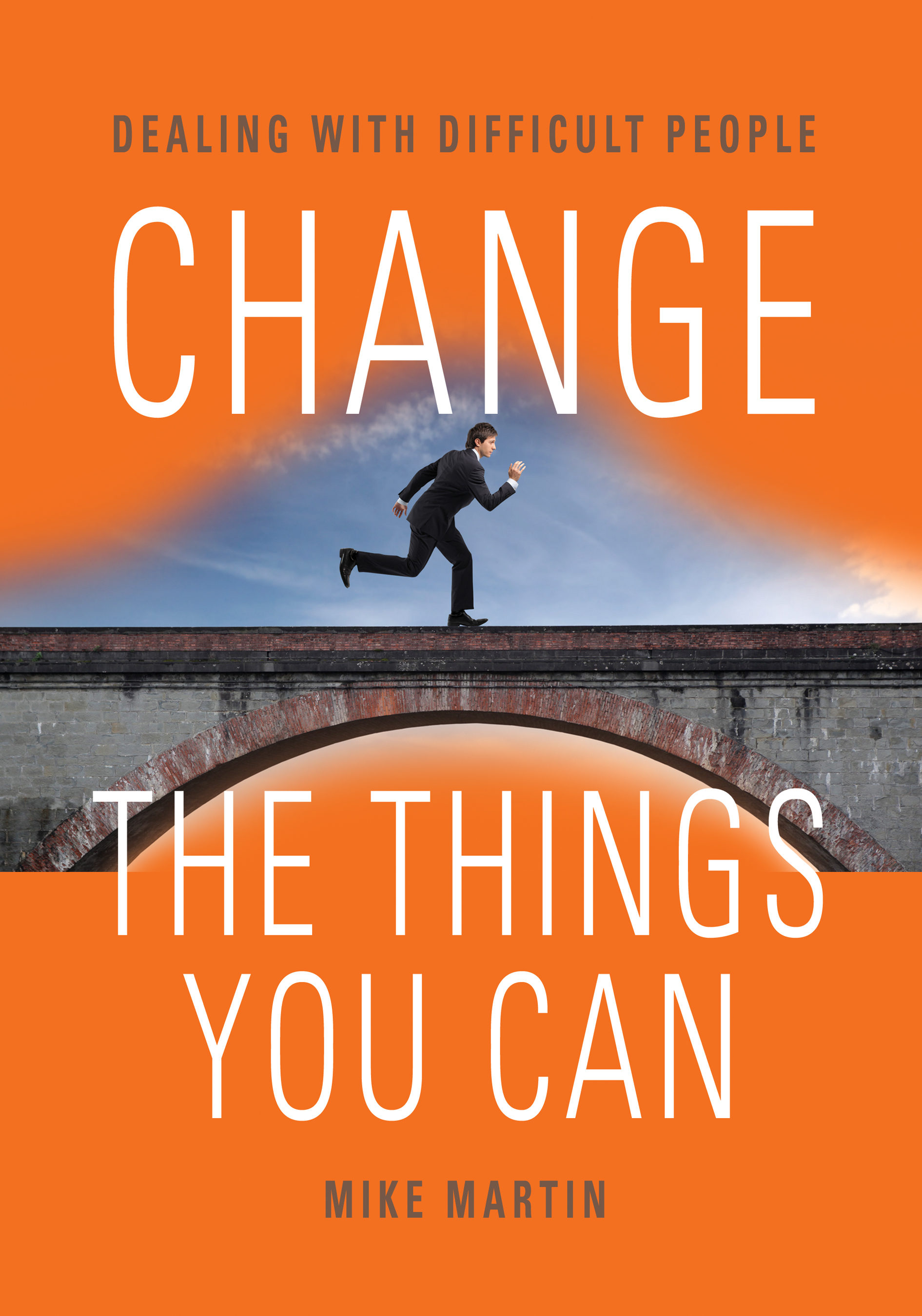
I am very pleased to announce the publication of my new book: Change the Things You Can (Dealing with Difficult People).
This book came from a lifetime of making mistakes in trying to deal with the most difficult people in my lifetime. It also came to me after writing hundreds of articles about resolving conflict in the workplace, dealing with bullies, and trying to improve the health and wellness of the modern workplace. Many of the situations and possible solutions I have developed relate to the workplace but the problems and solutions will work just as well in the other parts of life.
I have decided to publish this book on line using a Print On Demand system. That means that you can order the book (in print or e-book formats) on line at the following website:
http://booklocker.com/books/5576.html
You can also find it at on Amazon and Chapters.ca as well as most on line book retailers. One of the major reasons for using this publishing route is to make the book as “green” as possible and not to have boxes of books that nobody buys sitting around a warehouse (or my storeroom)
I would be honoured if you decide to purchase and read it. If you like it maybe you can recommend it to others. And I’d love to hear what you think of it-good, bad or indifferent. You can reach me by e-mail or visit me on line at http://www.changethethingsyoucan.wordpress.com
This website/blog will feature articles and thoughts about issues in workplace wellness, human resources, and communications.
Thank you for your time and consideration of this request.
Mike Martin
CBC.ca has a story about the the rising income gap between the very richest of Canadians and the rest of us. Most of us knew this already but it’s kinda nice to have the Conference Board confirm this.
The sad truth is that this is happening not because those rich foks are smarter or working harder than the rest of us. THey are benefitting from reduced income taxes and the generosity of a series of governments who have reduced their capital gains and corporate taxes.
There are things that can be done to turn this around but they will require a political will and a strong push from Canadians who want a fairer society. One of the ways to at least put on a bottom on this bottom is to look at some form of guaranteed annual income so that everyone has a chance to feed clothe and shelter their families. Even in a society built on greed that’s surely not too much to ask for.
Here is a link to my previous article on guaranteed annual income https://mike54martin.com/wp-content/uploads/2011/01/gai.doc and below is the link to the CBC.ca article.
“The income gap between rich and poor in Canada widened in the period from 1993 to 2009, the Conference Board of Canada reported Wednesday.
The richest Canadians increased their share of total national income while the poor and those with middle incomes saw their portions shrink, according to the board’s analysis, entitled “How Canada Performs.”
Incomes of the poor increased marginally in the period, it said, but the gap between rich and poor widened.”
http://www.cbc.ca/news/business/story/2011/07/13/income-gap-canada-conference-board.html
Workplace Wellness: Work can be a Dangerous Place
By Mike Martin
According to the Canadian Centre for Occupational Health and Safety (CCOHS) workplace violence is a growing concern for Canadian workers and the threat of violence at work is not just limited to physical assault. Workplace violence can include any act where a worker is abused, threatened, intimidated or assaulted in the course of his or her employment. This can include a range of actions including threatening behaviour, verbal or written threats, verbal abuse and of course physical abuse which includes hitting, shoving, pushing or kicking.
The extent of workplace violence may be hidden from the public eye since many acts go unreported and there has not been an active effort to collect statistics on workplace violence until recent years. But from April 1, 2008 to March 31, 2009, Ontario Ministry of Labour Inspectors made 417 field visits and issued 351 orders related to violence in the workplace inOntarioalone. There is also widespread evidence that workplace violence has dramatically increased in the last five years. According to the Canadian Initiative on Workplace Violence two thirds of organizations surveyed report an increase in aggressive acts within their workplaces and over eighty per cent report an increase in both formal incident reports and grievances.
Some professions by the nature of their work and their high level of interaction with high risk populations are more in danger of exposure to workplace violence that others. These include jobs that handle money or prescription drugs like cashiers or pharmacists, occupations that carry out inspection or enforcement duties or those working with volatile or unstable persons in social services or the criminal justice system.
At particular risk seem to be health care workers, correctional officers, social services employees, teachers and retail workers. There are also times of the day or night, month or year that seem to more likely to see acts of workplace violence. They include late at night or early morning, the end of the month before assistance checks arrive, Christmas and holidays, and for employee on employee violence pay days or performance appraisal time.
It may not be possible to prevent all possible acts of violence at work but there are measures that can be taken to make every workplace as safe as possible for employees, volunteers, clients and customers. These measures fall into three main categories: workplace design, administrative practices and work practices and in each area there are concrete steps that an organization can take to reduce the possibility of an employee being abused or attacked.
CCOHS offers the following helpful suggestions in each of these categories. In workplace design employers should consider factors such as workplace lay-out, use of signs, locks or physical barriers, lighting, electronic surveillance and building security. In particular organizations should consider installing physical barriers so that there is separation between staff and customers or clients and controlling the access to certain areas through coded cards or key systems. Administrative practices that can reduce the risk of workplace violence include strict controls on drugs or pharmaceuticals, limiting the amount of cash on the premises, installing a locked drop safe or arranging for cash pick up by a licensed security firm.
Work practices that can help prevent incidents of workplace violence include using a buddy system and never working alone, especially late at night or early in the morning. Other safe work practices could be having a designated contact person when someone is out of the office and regularly scheduled contact times. If the person does not check in at the appropriate time then an alarm is raised about their safety with security personnel or the police. For occupations and jobs that might require home visits there needs to be some client screening done in advance of the first home visit by the professional.
One of the best ways to ensure the overall safety of all employees is to have a written policy on workplace violence that outlines management’s commitment to a workplace that is free of violence, harassment and other unacceptable behaviours. This policy should be developed by both management and employee representatives and should define workplace violence in precise, concrete language that encourages both the development of preventative measures and the reporting of all incidents of violence. This policy should be posted in the workplace and a copy should be provided to every new employee as part of their orientation program.
It is time to bring workplace violence out of the shadows by recording all incidents of violence at work. This will help to build awareness on the part of workers and employers about the need to work together to prevent such incidents from arising in the future.
Mike Martin is a freelance writer and consultant specializing in workplace wellness and conflict resolution. He is the author of the soon to be released book “Change the Things You Can” (Dealing with Difficult People). For more information about Mike please visit:
Dealing with Difficult People: Harassment in the Workplace
By Mike Martin
We Don’t Have a Problem
Some people like to think that there is no harassment in their workplace because no one has ever complained about it. But just because no one has brought it forward doesn’t mean it doesn’t exist. The fact is that there are very few workplaces without some form of harassment or bullying and those suffering from this form of abuse may have a number of reasons why they do not want to bring this matter forward. This includes being afraid of retaliation, embarrassment or even losing their job. Most importantly they may feel that they won’t be believed, especially if the harassment is being done by their boss or supervisor. The fact of the matter is that harassment exists and every employer should have a proactive plan to deal with this issue.
Harassment can have moral, legal and financial impacts on an employer. Morally every employer should want the safest and healthiest working environment for its employees and legally an employer could be liable for damages under federal and provincial human rights legislation if they become aware of harassment and do nothing to stop or prevent it. But harassment also has a financial impact on the organization’s bottom line through loss of time by an employee who is being harassed, a reduction in productivity by the individual or their section, or the cost of replacing good employees who resign because they feel they are being abused in the workplace.
The first step that any employer should take is to develop and maintain an anti-harassment policy for their workplace. Educating all employees, managers and supervisors about harassment will not only create a safer workplace it will encourage employees to take responsibilities for their own actions and help them recognize the types of behavior that could classify as harassment. This also creates an openness for people who are being harassed to come forward with their complaints so that they can be dealt with in a fair and transparent manner.
Definitions
There are many different definitions of harassment but the Canadian Human Rights Commission categorizes harassment as occurring in three main areas: unwelcome behaviour that demeans, humiliates, or embarrasses; unwanted sexual behavior; or abuse of authority.
Demeaning, humiliating or embarrassing a person includes actions like touching or pushing, comments like jokes or name-calling, or displays like posters or cartoons. There are also prohibitions on harassment related to race, national or ethnic origin, colour, religion, age, sex, marital status, family status, disability, pardoned conviction, or sexual orientation covered under various pieces of human rights legislation. Disrespectful behaviour which is sometimes called “personal” harassment is not covered under legislation but some employers do choose to include this in their anti-harassment policy.
Unwanted sexual behaviour is probably better known as sexual harassment and it includes offensive or humiliating behaviour that is related to a person’s sex and sexual behaviour that creates an intimidating or hostile workplace. Sexual harassment can also occur when these behaviours could create a situation where a person thought that there were sexual conditions attached to their employment. There are a wide range of behaviours that might be classified as sexual harassment and they include asking questions about an employee’s sex life, commenting on someone’s sexual attractiveness, persisting in asking someone out when they have refused or displaying posters or pictures of a sexual nature.
Harassment under the abuse of authority category can occur when someone uses their authority to unreasonably interfere with another employee or that employee’s job. It might include actions like humiliation, threats or intimidation. It is important to note that this does not include the regular and normal managerial activities of evaluations, discipline and counseling. Abuse of authority is not covered under human rights legislation unless it involves one of the prohibited grounds. Some employers do however choose to include this issue in their anti-harassment policy.
Where Do We Begin?
The first step to creating a safer and harassment-free workplace is for the employer to take the lead in creating an environment where all employees know that harassment will not be tolerated and that employees feel safe in bringing forward their complaints and concerns. Secondly, everyone in the organization needs to know the consequences of harassment and what to do if they become aware of a harassment situation. Thirdly, there needs to be a training and awareness program for all staff, especially managers and supervisors to maintain the safe working environment.
Developing your own policy on harassment is also an important step because it clearly shows your employee group that you are serious about this issue and that they should take it seriously as well. The policy should have an opening statement that simply says that you as the employer will not tolerate harassment or harassing behaviour. It should also include an explanation of what harassment is and provide some examples do that people understand what you mean. Finally it should set out the process for making a complaint and how complaints will be reviewed and dealt with.
Involving all employees in developing the policy or providing comments on a draft policy is a good way to increase employee awareness of the issue and build employee commitment to the policy. This includes the management team and all supervisors who will later be tasked with applying the policy fairly regardless of who is involved in any harassment complaint. To facilitate this and create even greater employee buy-in the policy should make perfectly clear that all employees from the mailroom to the executive boardroom will be covered under this policy and that there will be no exceptions to this rule.
Education and Awareness
Once the policy is completed it should be widely circulated and supported by a communications and education strategy that ensures that all employees are fully aware of the new policy. This can include orientation sessions, posters, brochures and training sessions. All new employees should receive a copy of the policy as part of their introduction to the organization.
Managers and supervisors, and those employees who are designated to deal with complaints under the policy will need special attention and training so that they understand their responsibility for handling all complaints which arise. It is very important is to support the management team as they come up the learning curve on this issue.
Managers should be trained to take a leadership role in creating a safer workplace by not tolerating any harassing behaviour in their area of responsibility and in making an early identification of harassment in the workplace. The earlier a problem can be identified the faster it can be resolved.
It is also important that those who are chosen as anti-harassment investigators or mediators should be seen by the employee group as being as fair and unbiased as possible because of the role that they will be asked to play. Anti-harassment investigators or mediators will need specialized training in how to receive process and resolve complaints. How they handle complaints may determine the ultimate success or failure of your anti-harassment policy.
Monitoring Your Progress
As your policy is being implemented there will lots of questions raised about what is or isn’t harassment and someone on staff will need to respond quickly and accurately to these concerns. You may need to consider an outside resource or consultant to assist in this area. Some organizations and companies also outsource their entire harassment investigation process to a third party to ensure fairness, confidentiality and compliance with the policy.
There is also a need to periodically monitor and review your anti-harassment policy and program to ensure that it is working effectively and meeting your goals. This can be accomplished by reviewing complaints received and their resolution rate as well as by consulting with the management team. The whole staff group needs to be asked for their opinion about how well they think the process is going and this can be done through surveys and focus groups in the workplace.
Remember that as an employer you are legally responsible for actions that take place within your workplace. If a case of harassment by one of your employees makes it way to court they may ask you to prove that you did everything possible to prevent the harassment from occurring and dealt with it properly once you became aware of the situation.
You may never eliminate harassment from your workplace but if you follow these steps you will go a long ways to protecting your employees and your entire organization.
Mike Martin is a freelance writer and consultant specializing in workplace wellness and conflict resolution. He is the author of “Change the Things You Can” (Dealing with Difficult People). For more information about Mike please visit:

